
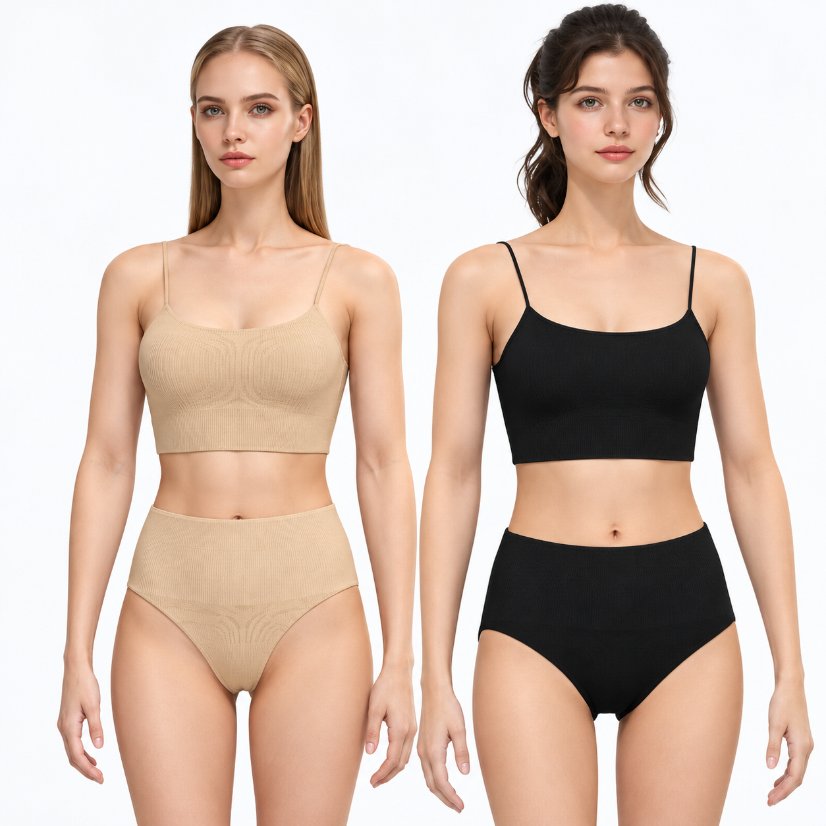
A brief RFQ should identify the construction and finish at each relevant edge and junction, rather than rely on one broad word such as seamless. Ask the supplier to mark the waistband opening, leg openings and other construction areas on a diagram and describe the proposed method for each. Lily Underwear’s high-waisted brief page uses seamless and bonding-related language. Treat that wording as a starting point for a version-specific construction enquiry, without assuming that a photograph proves how every part of the garment is made.
Give the edges and junctions separate references
Begin with the exact brief style and colourway you want quoted. Use an annotated front and back view, with separate references for each edge or junction that matters to your brief. Ask the supplier to explain the construction at those references using its own proposed specification. A garment may contain several construction areas, and a general style description does not define each one. Keep the requested diagram connected to a named version so details from another sample or related product cannot be carried into the offer accidentally.
Ask the supplier to distinguish the edge appearance from the method used to create it. A smooth-looking edge in a photograph does not establish whether it is folded, bonded, stitched or formed through another process. Likewise, a visible line is not enough to identify the complete construction behind it. Request a written description and the detail reference needed to interpret the proposal. Leave any unconfirmed area marked as a question instead of completing the construction map from visual guesswork or general underwear terminology.
Clarify what the catalogue wording covers
If the supplier uses seamless wording in the quotation, ask which areas that description is intended to cover. Request a separate description for any junction, reinforcement or label attachment that is relevant to the offered version. The purpose is to define the commercial specification accurately, not to impose one interpretation of a broad catalogue term. Ask the supplier to identify any difference between the website reference, the proposed sample and the garment it would supply for the order. Keep those differences visible before accepting the version.
Keep material and performance questions separate from the construction map. A stated bonding method does not independently verify fabric composition, comfort, durability or a shaping result. If those fields matter to your buying brief, request the relevant version-specific information and supporting evidence. The product page includes several promotional statements, but they should not fill gaps in the construction proposal. A clear map can establish what the supplier says it will make while leaving unverified effects or material declarations for their own review.
An edge-construction schedule for the enquiry
Construction field | Buyer reference | Supplier confirmation needed
Garment version | Style, colourway and item code | Exact brief covered by the proposal
Waist opening | Marked edge reference | Proposed finish and construction method
Leg openings | Separate location references | Method and any version differences
Other junctions | Areas requiring clarification | Proposed joining or reinforcement details
Label attachment | Requested label location and format | Proposed attachment method
Sample link | Diagram and specification revision | Details represented by the sample
Use the schedule when comparing several supplier proposals or preparing a retailer’s product file. An importer serving UK and European collections, for example, can keep construction references consistent while requesting different packaging language or commercial artwork. State destination requirements and documentation needs separately. A market name, a high-waisted silhouette or a seamless category label does not establish material grade, certification or performance. Ask the supplier to connect each declaration to the exact offered garment instead of extending a general catalogue claim to every option.
Make the sample show the specified details
Ask which sample or detail images the supplier proposes to provide for the marked areas. A whole-garment presentation can identify the style, while a labelled close view or an inside view may help explain a particular construction reference. Request the information needed to interpret the supplier’s proposal without assuming that one image proves every field. If a sample uses a different edge finish or label attachment, record the difference and ask what version is intended for the commercial offer before carrying the sample decision forward.
Before ordering, compare the final quotation, construction schedule and accepted sample references against one revision. Ask how proposed changes to an edge method or junction will be disclosed. For repeat orders, provide the accepted map and request confirmation that the same construction is being offered. Current material options, pricing, minimum quantities, packing and timing should be confirmed for that defined version. The official product image is a useful style reference, but it does not independently establish those specifications or guarantee a wearer-related result.
FAQ
Does seamless mean every part has no joining detail?
Ask the supplier to define the scope of its wording for the quoted version. Request a location-by-location description of relevant edges and junctions. A broad catalogue term should not replace the construction map or conceal an area that still needs confirmation.
Can a smooth-looking edge prove adhesive bonding?
Appearance alone does not verify the method. Ask for the supplier’s written construction description and an identified detail reference for the exact garment version. Keep the observed appearance and the declared process as separate fields until the proposal is clarified.
Should label attachment be included in the map?
Include it when it matters to your brief. State the requested label location and format, then ask the supplier to describe the proposed attachment method. Do not assume the catalogue’s general construction wording also defines how every label will be attached.
What should accompany an edge-construction change?
Request a revised diagram or schedule identifying the affected location and proposed method, together with the appropriate sample or detail reference. Keep the quotation linked to that revision so an earlier appearance decision is not mistaken for acceptance of a different construction.
Product reference and enquiries
Product reference: https://lilyunderwear.cn/product/high-waisted-shaping-tummy-control-pants/
Catalogue source: https://lilyunderwear.cn/
Contact Lily Underwear: https://lilyunderwear.cn/contact/
More buyer articles: https://lilyunderwear.cn/blog/